
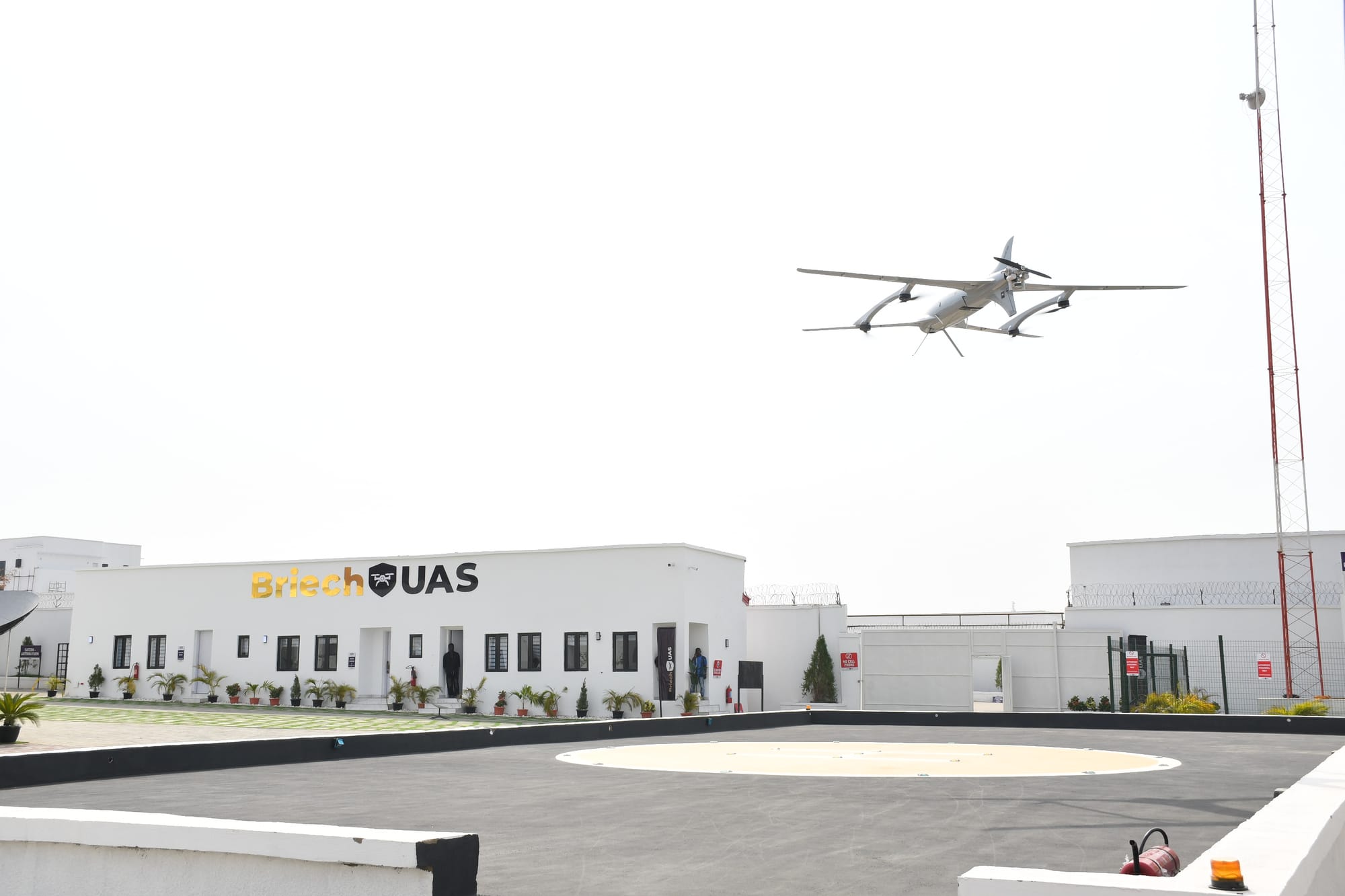
By the BRIECH UAS Editorial Team — Annual Group Magazine, 2026 Edition.
In Brief: This feature walks through how Briech UAS’s four divisions — manufacturing, ISR missions, precision strike, and MRO — work together as one integrated capability, and where the company is headed through 2030.
In an era where information advantage determines the outcome of critical operations and where precision matters more than ever, BRIECH UAS has quietly built one of the most capable drone manufacturing and services enterprises in the region. From carefully-assembled airframes rolling off our production floor to live Intelligence, Surveillance and Reconnaissance (ISR) missions and precision strike engagements, we are shaping what is possible with unmanned technology.
From Concept to Capability: Our Manufacturing Story
The story of BRIECH UAS is not one that began in a boardroom or with a procurement catalogue. It started with a question — could we build, maintain, and operate unmanned aerial systems that genuinely serve the real-world intelligence and operational needs of our clients? The answer, as the past years have demonstrated, is an unequivocal yes.
Today, our production floor is equipped to design and assemble a range of fixed-wing, rotary-wing, and hybrid VTOL (Vertical Take-Off and Landing) drone platforms. Each aircraft is engineered around mission requirements — not the other way around. Whether a client needs a long-endurance platform for persistent area surveillance or a compact, agile system for close-in reconnaissance, BRIECH UAS configures and builds to specification.
Our manufacturing capability extends beyond airframe assembly. We integrate flight control systems — including advanced autopilot stacks such as those built on ArduPilot and PX4 — along with mission-specific payloads: electro-optical and infrared (EO/IR) cameras, communication relay modules, and electronic warfare support packages. Battery management systems are calibrated to maximise endurance, and propulsion systems are rigorously tested before any platform leaves our facility.
Key Capability: End-to-end drone manufacturing from airframe integration to avionics configuring, payload installation, and pre-delivery acceptance testing – all conducted in-house.
ISR Services: Persistent Awareness, Actionable Intelligence
Intelligence, Surveillance, and Reconnaissance remain the most enduring value proposition of unmanned aerial systems. Our ISR service line delivers persistent, real-time aerial coverage to clients across security, infrastructure protection, maritime domain awareness, and border monitoring sectors.
Our ISR operations are underpinned by a trained cadre of UAV pilots, sensor operators, and ground exploitation analysts who work as an integrated team. BRIECH UAS operates under a structured mission planning cycle: pre-mission intelligence preparation, route and sensor profile planning, live execution with real-time feeds to the client ground station, and post-mission data exploitation and reporting.
“We do not just fly drones. We deliver decision-quality intelligence to the people who need it most, when they need it most.”
Among the mission profiles our ISR teams have executed are wide-area persistent surveillance of critical national infrastructure, pattern-of-life analysis over designated zones of interest, geospatial mapping and change detection, event security coverage, and search-and-rescue support operations. In every case, our standard is not merely to collect — but to provide processed, relevant, and timely intelligence that enables our clients to act.
Our platforms are equipped with stabilised gimbals carrying dual EO/IR sensors capable of operating effectively by day or night. High-definition video feeds are encrypted and streamed directly to client command posts, while onboard recording ensures full data retention for post-mission exploitation. We also offer integration with existing client C2 (Command and Control) infrastructure where required.
Precision Strike: The Loitering Munitions Capability
The emergence of loitering munitions — often referred to in popular discourse as “kamikaze drones” or one-way attack systems — represents one of the most significant shifts in tactical aerial operations in decades. BRIECH UAS has developed a dedicated precision strike capability that allows clients to engage time-sensitive, high-value targets with minimal collateral risk and without the cost and logistics burden of conventional munitions or manned aircraft.
Our loitering munition systems are designed around three core principles: precision, adaptability, and operator control. Each system is fitted with a high-accuracy seeker and warhead optimised for the target category in question. Critically, our systems support operator-in-the-loop engagement protocols — no strike is executed without deliberate human authorisation, ensuring that our clients maintain legal and ethical command responsibility for all engagements.
Design Philosophy: All our precision strike systems incorporate a man-in-the-loop abort capability, allowing operators to cancel an engagement up to the final seconds of terminal approach.
We provide end-to-end strike mission support: pre-mission target confirmation and engagement planning, system preparation and launch, real-time operator control during the mission, and post-strike battle damage assessment (BDA) using onboard recording. Our teams work closely with client tactical commanders to ensure that each engagement is conducted in accordance with applicable rules of engagement and international humanitarian law principles.
The combination of our ISR and strike capabilities within a single division creates a uniquely coherent intelligence-to-effects pipeline. Targets identified and tracked by our ISR platforms can — where authorised — be immediately transitioned to a strike engagement without the delays inherent in conventional fire coordination chains.
MRO Excellence: Keeping the Fleet Mission-Ready
A drone that cannot fly is a liability, not an asset. BRIECH UAS operates a dedicated Maintenance, Repair, and Overhaul (MRO) department that sustains both our own operational fleet and client platforms under contracted maintenance agreements. Our MRO team is drawn from engineers with deep hands-on experience across a range of systems — from commercial-grade multirotor platforms to purpose-built tactical UAVs.
Our maintenance philosophy follows a structured inspection regime: pre-flight checks, periodic scheduled maintenance, unscheduled corrective maintenance in response to system faults, and post-incident repair and airworthiness restoration. Our technicians are proficient on flight controller diagnostics, ESC fault isolation, propulsion system overhaul, payload repair, and firmware configuration management.
We have invested in diagnostic tooling, calibration equipment, and a growing spares inventory to minimise aircraft-on-ground (AOG) time for our clients. Our MRO team also documents all maintenance actions in accordance with formal technical records practices, supporting airworthiness tracking and regulatory compliance.
MRO Commitment: Target turnaround times for corrective maintenance actions are measured in hours, not days — because operational readiness cannot wait.
People and the Human Edge
Technology alone does not win missions. Our most valuable asset is our people — the engineers, pilots, analysts, and maintainers who bring our platforms to life and execute every mission with discipline and professionalism. BRIECH UAS invests deliberately in human capability.
Our human resource includes certified UAV pilots, skilled sensor operators, mission planners, communications security personnel, and emergency procedure handlers. We regularly conduct realistic mission rehearsals and tabletop exercises to ensure our teams are prepared for the full spectrum of operational conditions, including degraded communications, GPS-denied environments, and adversarial interference scenarios.
We are also actively building depth in our workforce, ensuring that critical skills are not held by a single individual. Structured mentorship arrangements pair experienced operators with newer personnel, and we partner with aerospace engineering institutions to develop the next generation of unmanned systems professionals from within Nigeria.
“Our goal is a team where every member understands not just how to operate the system, but why every decision in the air matters.”
Looking Forward: The Road to 2030
The unmanned systems sector is evolving rapidly, and BRIECH UAS is positioned to grow with it. In the near term, our focus areas include expanding our platform portfolio to include longer-endurance hybrid-electric propulsion systems, enhancing our sensor integration capabilities for multi-intelligence collection, and deepening our artificial intelligence and autonomy integration roadmap.
We are also exploring the development of swarm coordination capabilities — the ability to deploy and manage multiple unmanned platforms in coordinated operations — which represents the frontier of tactical unmanned systems employment. This capability, when it matures, will dramatically multiply the situational awareness and effects capacity available to our clients.
On the regulatory and standards front, we are engaging with relevant authorities to ensure that our operations are conducted within evolving national and international frameworks for unmanned aerial systems. We believe that a strong regulatory environment ultimately benefits responsible operators such as ourselves, and we actively contribute to its development.
Our ambition is clear: to be the partner of choice for organisations across the region that require unmanned aerial capability — whether for intelligence gathering, precision effects, infrastructure monitoring, or humanitarian support operations. We build every aircraft, train every operator, and plan every mission with that ambition in view.
BRIECH UAS remains committed to delivering excellence in every aircraft we manufacture, every mission we execute, and every client relationship we build. We are proud to represent the Group’s forward edge in unmanned technology, and we look forward to the opportunities that the years ahead will bring.
Frequently Asked Questions
What services does Briech UAS provide beyond drone manufacturing?
Briech UAS offers a full operational stack: in-house airframe and avionics manufacturing, Intelligence, Surveillance and Reconnaissance (ISR) mission services, a precision strike (loitering munitions) capability, and a dedicated Maintenance, Repair and Overhaul (MRO) division for fleet sustainment.
Does Briech UAS operate its own ISR missions, or only sell drones?
Both. Briech UAS manufactures the aircraft and also runs ISR missions directly with its own trained UAV pilots, sensor operators, and ground exploitation analysts, delivering processed intelligence rather than raw footage.
How does Briech UAS's precision strike capability maintain human control?
All Briech UAS loitering munition systems use operator-in-the-loop engagement protocols, meaning no strike executes without deliberate human authorisation, and operators retain a man-in-the-loop abort capability up to the final seconds of terminal approach.
What does Briech UAS's MRO division do?
The Maintenance, Repair and Overhaul (MRO) division sustains both Briech UAS’s own fleet and client platforms under contracted maintenance agreements, covering flight controller diagnostics, propulsion overhaul, payload repair, and firmware management, with corrective maintenance turnaround measured in hours.
What is Briech UAS's roadmap for the next few years?
Near-term priorities include longer-endurance hybrid-electric propulsion, deeper multi-intelligence sensor integration, expanded AI and autonomy capabilities, and the development of coordinated swarm operations across multiple unmanned platforms.